
Photoresistor module sensor LDR
0.65 د.ك
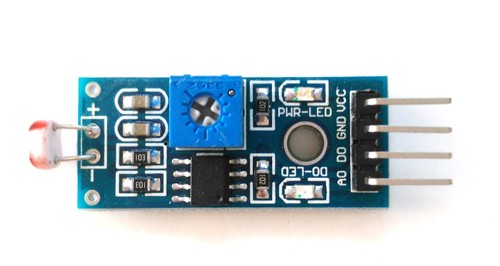
The Photoresistor Module Sensor LDR detects ambient light intensity for Arduino, automation, and smart lighting projects. Additionally, the module provides both analog and digital outputs for flexible light sensing applications.
In stock


Description
-
Photoresistor Module Sensor LDR for Arduino
The Photoresistor Module Sensor LDR is a reliable light detection module designed for Arduino, robotics, automation, and smart electronics projects. In addition, the module uses a light-dependent resistor (LDR) to detect changes in ambient light intensity with stable and responsive performance.
Moreover, the module provides both analog and digital output signals, allowing users to build flexible light-sensitive electronics systems. As a result, developers can create automatic lighting systems, smart street lights, laser alarm systems, and environmental monitoring projects more efficiently.
Furthermore, the onboard LM393 comparator and adjustable potentiometer simplify sensitivity calibration for different lighting conditions. Therefore, the module is suitable for beginners, students, makers, and professional developers alike.
What Is an LDR Sensor Module?
An LDR sensor module is an electronic device that detects light intensity using a photoresistor whose resistance changes according to the amount of light falling on its surface. Additionally, the resistance decreases when light intensity increases and rises when the environment becomes darker.
At the same time, the module converts these resistance changes into analog and digital output signals that Arduino and other microcontrollers can process easily. Because of this, the sensor is widely used in smart lighting, automation systems, robotics, and environmental sensing applications.
Likewise, the compact module design simplifies installation and wiring for embedded systems. Consequently, light detection projects become significantly easier to develop.
You can display live light readings using the 0.96 Inch OLED LCD Screen I2C 128X64 or the 16×2 LCD Display I2C Arduino for real-time monitoring systems.
Key Features
- Photoresistor light detection module
- Sensitive LDR light sensor
- Analog and digital outputs
- Adjustable sensitivity control
- LM393 comparator onboard
- Compact and lightweight design
- Suitable for Arduino projects
- Stable light sensing performance
- Beginner-friendly integration
- Low power consumption
Additionally, the module supports both light-activated and dark-activated automation systems.
Technical Specifications
- Sensor Type: Photoresistor (LDR)
- Comparator Chip: LM393
- Operating Voltage: 3.3V – 5V
- Output Type: Analog and digital
- Detection Type: Light intensity sensing
- Sensitivity Adjustment: Supported
- PCB Size: Approximately 3.2cm × 1.4cm
- Application Type: Light detection and automation
Overall, these specifications make the module highly suitable for smart lighting and environmental monitoring systems.
Smart Light Detection Applications
This LDR sensor module is widely used in projects that require automatic light sensing and environmental monitoring. In addition, the analog output allows users to measure changing light intensity levels continuously.
Furthermore, the module performs efficiently in smart automation and robotics systems. Therefore, users can create automatic night lamps, street lighting systems, and laser security devices more effectively.
At the same time, the adjustable potentiometer improves flexibility for different environments and sensitivity requirements. As a result, the module performs exceptionally well in educational and DIY electronics projects.
For laser-based alarm systems, the module works perfectly with the 5V Laser Head Laser Diode to build light interruption security systems.
Why Choose This Arduino Light Sensor?
This Arduino-compatible light sensor combines reliable light detection, adjustable sensitivity, and simple integration in one compact solution. In addition, the module supports both analog and digital outputs for flexible programming and automation.
Furthermore, the sensor supports direct connection to Arduino analog and digital pins without requiring complicated communication protocols. Therefore, beginners can quickly start building smart lighting and environmental sensing systems.
Most importantly, LDR modules remain one of the most popular light sensors in Arduino electronics projects. Consequently, users can easily find tutorials, wiring guides, and sample code online.
You can easily connect the module to the Arduino Nano V3.0 R3 Board CH340G or the Mega 2560 R3 for advanced automation projects.
Applications
This module is suitable for many electronics projects, including:
- Arduino light detection projects
- Automatic street lighting
- Smart home automation
- Laser security systems
- Environmental monitoring
- DIY electronics
- Robotics systems
- Embedded electronics projects
- Smart night lamps
- Educational engineering projects
Additionally, the sensor is commonly used in smart automation and robotics learning systems.
For automation systems, the module can trigger the Relay Module 1 Channel to control lights and appliances automatically.
Compatible With
- Arduino UNO
- Arduino Mega
- Arduino Nano
- ESP32
- ESP8266
- Raspberry Pi
- OLED displays
- LCD displays
- Relay modules
- Smart automation systems
Furthermore, the module works seamlessly with many Arduino-compatible sensors and accessories.
Tutorial
The Photoresistor Module Sensor LDR can be connected directly to Arduino analog or digital input pins for light detection applications. Additionally, users can measure ambient light intensity and trigger LEDs, relays, alarms, and displays using Arduino IDE programming.
Moreover, many tutorials and open-source examples are available online for beginners and advanced developers alike. Therefore, users can quickly build automatic lighting and environmental monitoring systems.
In conclusion, the Photoresistor Module Sensor LDR is an excellent choice for anyone looking for a reliable, beginner-friendly, and affordable light sensing solution for Arduino and automation projects.