
Micro:bit V2 By BBC microbit kit
17.00 د.ك
The BBC Micro:bit Development Board is an educational microcontroller platform designed for coding, robotics, STEM learning, IoT applications, and DIY electronics projects. Additionally, the Micro:bit provides built-in sensors, wireless communication, and beginner-friendly programming for students and makers.
In stock
Description
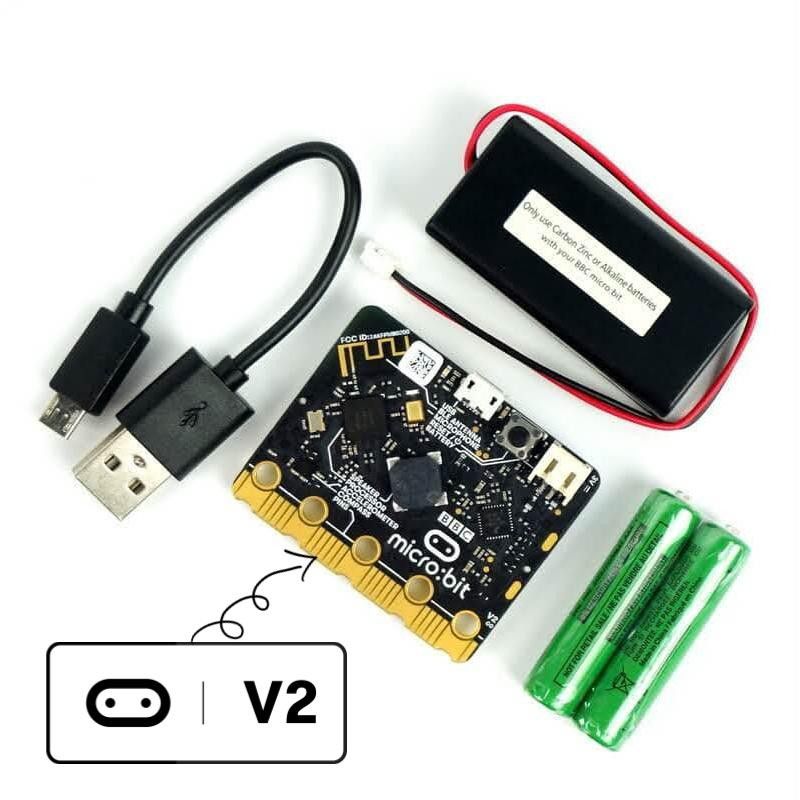
This micro:bit v2 Go Bundle is the perfect starter kit for the BBC micro:bit v2. It includes everything you need, even a little USB cable and batteries, to begin learning with hardware and software. If you only need the micro:bit board without accessories,

Designed specifically for kids and beginners, the micro:bit is a pocket-sized computer that you can code, customize and control to bring your digital ideas, games and apps to life. It’s a small, code-able device that is a non-intimidating introduction to programming and making – switch on, program it to do something fun – wear it, customize it, develop new ideas.
At half the size of a credit card, you will be surprised at the amount of hardware each board is equipped with, including 25 red LED lights that can flash messages. There are two programmable buttons that can be used to control games or pause and skip songs on a playlist. The micro:bit can even detect motion and tell you which direction you’re heading. It can also use Bluetooth Low Energy (BLE) to interact with other devices and the Internet.

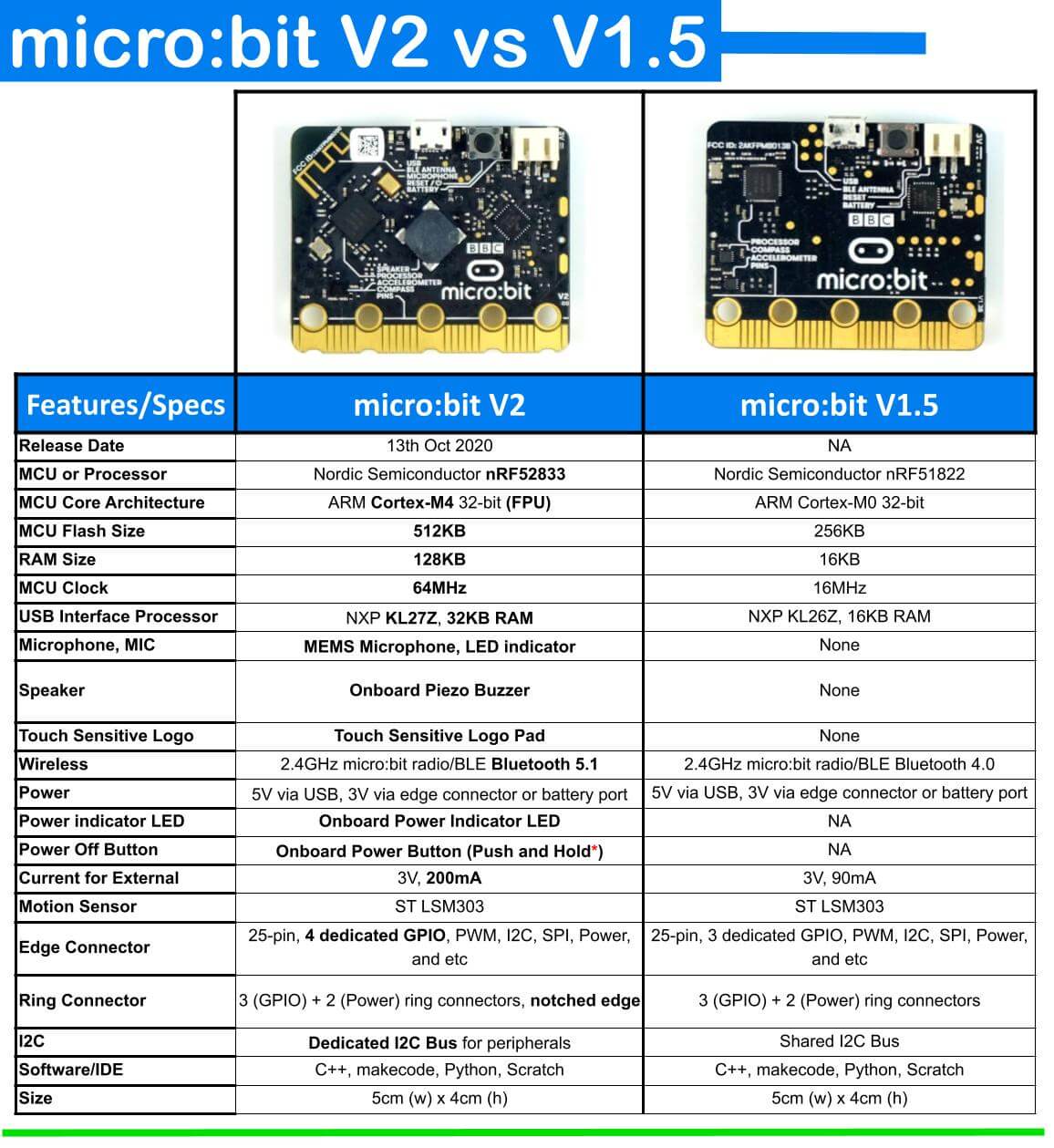
Taking a closer look at the front of the V2 board, we can see the 5×5 LED array is still there for you to draw on, display words, numbers and other information, and of course the two programmable cute buttons! V2 board comes with a MEMS microphone input hole and a mic indicator LED. If the sound input is enabled in the program or your code, the mic indicator will be illuminated. And not to forget the micro:bit logo, it is now a capacitive touch sensor. If you look carefully, it is now gold plated PCB instead of the color mask on the previous version board 🙂 So it can be used to detect touch. Awesome improvement!

On the back of the board, you will find the upgraded brains of the micro:bit. The microcontroller on the micro:bit V2 has been upgraded to nRF52833 with double the memory size to 512KB Flash, and an 8 times larger size of RAM to 128KB. With the upgrades of the main controller, micro:bit V2 is now Bluetooth 5.1 and also BLE (Bluetooth Low Energy).
Besides the MCU, the co-microcontroller that handles USB connection, KL26Z with 16KB RAM is being upgraded to KL27Z with 32KB of RAM too. micro:bit V2 still comes with an accelerometer, compass, and Bluetooth Smart antenna, as well as a micro USB and two-pin JST connector for different power options.
Finally, at the bottom of the board, you will still get the 20 gold-tabbed edge pins however, the five-ring connectors (three for digital/analog I/O, two for power and ground) for hooking up external components now come with notched edges. These notched edges will help the insert to the socket. And you can always use the crocodile/alligator clip 🙂

Of course, the intuitive mobile app that lets you send your code to your micro:bit over Bluetooth (without using a USB cable) and more remains compatible with the new micro:bit V2. With this app, you will be able to interact with your micro:bit on a higher level of accessibility.
If you’re new to coding and hardware, then the micro:bit V2 Go Bundle is a great place to start. It’s incredibly easy to use and a perfect platform to help you leapfrog onto other microcontrollers and computers such as Circuit Playground, Arduino, Feather, or even Raspberry Pi.
- The official Go bundle of micro:bit V2
- Comes with extra accessories: microB USB Cable, two-cell AAA battery holder and two AAA batteries
- 32-bit ARM Cortex-M4 CPU
- Main microcontroller: Nordic Semiconductor nRF52833
- Clock Speed: 64MHz
- Memory size: 512KB Flash
- RAM size: 128KB RAM
- USB Interface: NXP KL27Z with 32KB RAM
- 5×5 LED Matrix Display (Red LEDs)
- Two Programmable Buttons
- Touch Sensitive micro:bit logo
- Additional Power Indicator LED and Mic input indicator LED
- Built-in MEMS microphone input
- Onboard Accelerometer, Compass, Light and Temperature Sensors
- Wireless Communication, via Bluetooth 5.1 and BLE and 2.4GHz Radio
- Edge Connectors:
- Total 25 pins: 20 smaller pitch to pitch pins, 5 RINGS Notched Edge pins
- 4 Dedicated GPIO, PWM, I2C, SPI, Power and etc.
- 5 Ring pins for connecting crocodile clips or banana plugs
- 20-pin Edge Connectors, 5 notched edge Connectors
- Dedicated I2C bus for peripherals
- Power Button to power off the MCU
- Micro USB Type-B Connector
- JST-PH Battery Connector (Not JST-XH)
- Reset Button with Status LED
- Available current for external devices: 200mA
- Programming Platform: C++, Makecode, Python, Scratch
- Size: 5cm (w) x 4cm (h)
- 1 x BBC micro:bit V2 Board
- 1 x Micro USB cable, 6″ end-to-end
- 1 x Two-cell AAA battery holder
- 2 x AAA battery
The BBC Micro:bit Development Board is a compact and powerful educational microcontroller platform designed for coding, robotics, STEM education, IoT systems, and interactive electronics projects. Because the board includes built-in sensors, LEDs, buttons, Bluetooth communication, and programmable GPIO pins, it provides an excellent learning environment for beginners and students.
Additionally, the Micro:bit simplifies programming and electronics development through beginner-friendly coding platforms and hands-on experimentation. Therefore, it is widely used in schools, educational labs, coding workshops, robotics clubs, and STEM learning environments.
Moreover, the Micro:bit can be integrated with the Arduino UNO R3 for advanced electronics and automation projects.
What is the BBC Micro:bit?
The BBC Micro:bit is a programmable educational development board created to teach coding, electronics, and embedded systems concepts through practical projects. Moreover, it includes built-in sensors and wireless communication features that allow users to create interactive applications without requiring complex hardware.
Because of its simple programming environment and compact design, the Micro:bit is ideal for children, students, beginners, and educators learning programming and electronics fundamentals.
At the same time, the board supports robotics and IoT applications using the ESP8266 WiFi Wireless Module for internet-connected systems.
Key Features
- BBC Micro:bit development board
- Beginner-friendly coding platform
- Built-in LED display
- Integrated buttons and sensors
- Bluetooth wireless communication
- Supports STEM education
- Ideal for robotics projects
- Suitable for IoT applications
- Compact portable design
- Easy programming environment
- Supports embedded systems learning
- Excellent for DIY electronics projects
Technical Specifications
- Product Type: Educational Development Board
- Platform: BBC Micro:bit
- Wireless Communication: Bluetooth
- Integrated LED matrix display
- Built-in sensors and buttons
- GPIO interface support
- USB programming support
- Suitable for coding and robotics projects
Applications
The BBC Micro:bit Development Board is suitable for many educational and embedded systems applications. Furthermore, its built-in features make it ideal for learning and experimentation.
Common applications include:
- Coding education
- Robotics projects
- STEM learning
- IoT systems
- Smart automation projects
- DIY electronics projects
- Interactive electronics
- Sensor experiments
- Wireless communication systems
- Educational laboratory projects
- Embedded systems learning
- Smart monitoring systems using the ESP32 Development Board
Why Choose the BBC Micro:bit?
The BBC Micro:bit provides a beginner-friendly environment for learning programming, electronics, and embedded systems development. Additionally, the integrated sensors and display simplify project building without requiring additional hardware.
Moreover, the board supports graphical coding and text-based programming for users of different skill levels. Because of this, students and educators can quickly create interactive projects while learning real-world programming concepts.
Overall, the Micro:bit is an excellent choice for students, teachers, makers, robotics developers, and STEM education programs working with the Breadboard MB-102 and embedded electronics systems.
Compatibility
The BBC Micro:bit is compatible with:
- Windows computers
- macOS systems
- Linux systems
- Arduino projects
- Embedded electronics
- Sensors and modules
- Robotics kits
- Smart automation systems
- DIY electronics projects
- STEM learning platforms
Additionally, the board works perfectly with accessories such as the Jumper Wires Kit and external sensor modules.
Tutorial Section
Getting started with the BBC Micro:bit is simple and beginner-friendly. First, connect the board to your computer using a USB cable. After that, create programs using graphical coding tools or text-based programming environments and upload them to the board.
For example, you can use the Micro:bit to:
- Create LED display animations
- Build robotics projects
- Develop smart automation systems
- Learn coding fundamentals
- Create wireless communication projects
- Build interactive educational systems
Additionally, the Micro:bit can be combined with the 37 in 1 Sensor Kit Compatible with Arduino for advanced sensor experiments and STEM projects.
Conclusion
The BBC Micro:bit Development Board is an excellent educational platform for coding, robotics, STEM education, IoT systems, and embedded electronics projects. Because it combines built-in sensors, wireless communication, and beginner-friendly programming into a compact board, it is widely used in modern electronics learning environments.
Furthermore, its educational flexibility, easy programming tools, and interactive hardware features make it an ideal solution for students, teachers, makers, and robotics enthusiasts.